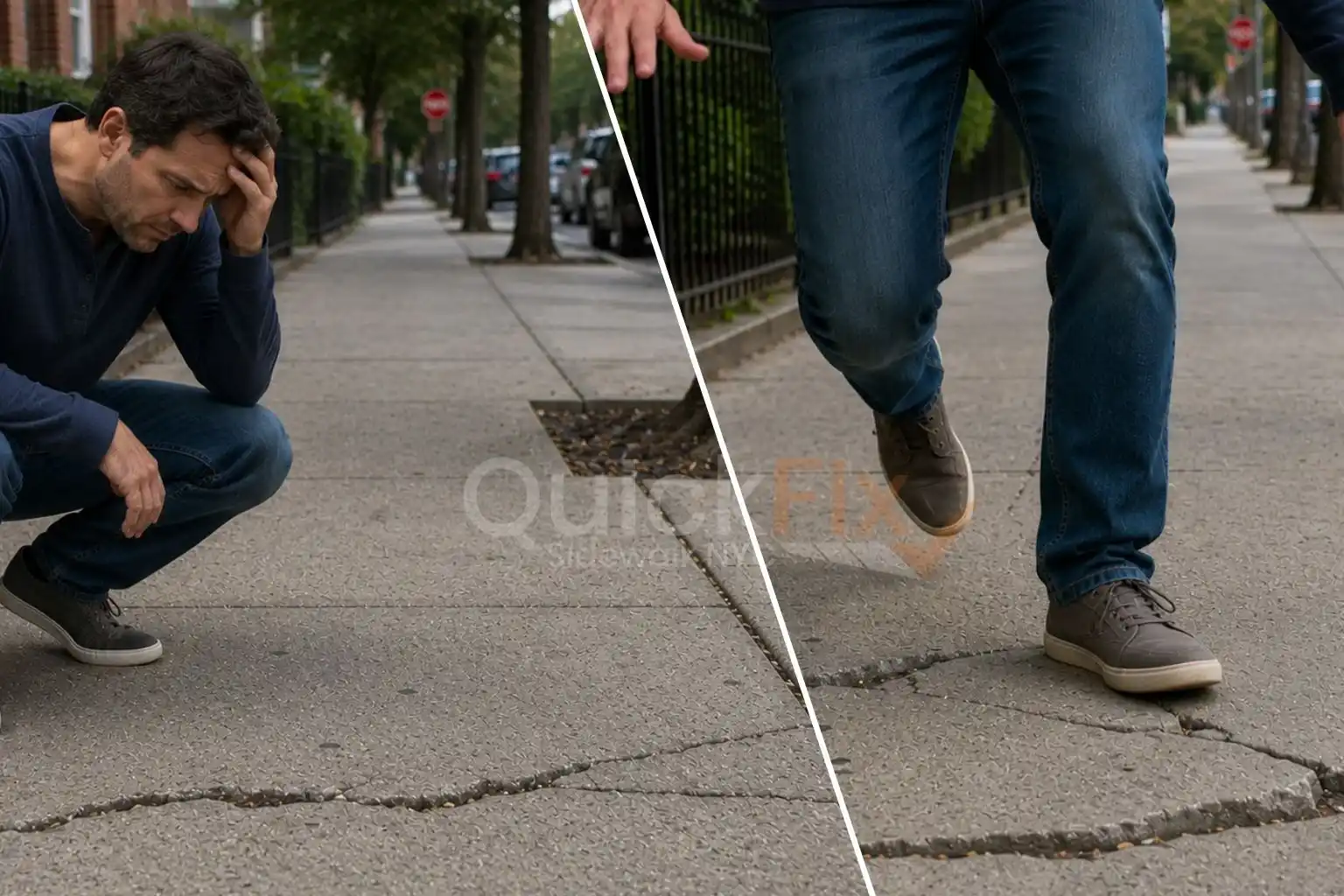
No, standard homeowners insurance does not cover the cost of fixing a damaged sidewalk. If your slab cracked from age, tree roots, or a DOT violation notice, that repair bill lands on you. Liability works differently. Your policy can step in if someone gets hurt on that sidewalk, but only under specific conditions.
Here's the breakdown of what your policy actually protects and where NYC's sidewalk laws leave you exposed.
Why Sidewalk Wear and Tear Isn't a Covered Expense
Insurers treat sidewalk maintenance the same way they treat mowing your lawn or repainting your siding. It's your job, not theirs. Most standard homeowners insurance policies don't cover sidewalk repairs stemming from normal wear and tear or DOT violations, since insurers see maintenance as a routine property owner responsibility. None of these situations register as an accident in the eyes of your insurer. They register as deferred maintenance, and deferred maintenance never qualifies as a covered peril.
Most claim denials trace back to one of these four causes:
-
Slabs that settled and cracked over time
-
Lifts caused by tree roots pushing through concrete
-
Freeze-thaw damage from winter weather
-
A DOT violation notice citing a defect you let sit too long
If your damage falls into one of these categories, expect a denial before you even file.
The "Other Structures" Coverage Category, and Why Sidewalks Get Shortchanged
Here's something most homeowners never consider asking about. Your sidewalk technically does fall under a real coverage category on your policy, called "other structures." It's the same bucket that covers fences, driveways, patios, and detached garages. The problem is the size of that bucket. Other structures' coverage typically caps out around 10% of your dwelling coverage limit, so a $500,000 home might only carry $50,000 for every structure on the property that isn't the house itself. That $50,000 has to stretch across your fence, your patio, your pool deck, and your sidewalk all at once.
Replacement Cost vs. Actual Cash Value for Driveways and Sidewalks
Even when a sidewalk claim gets approved, the payout rarely feels generous, and the reason comes down to how it's valued. Detached buildings like a garage or shed usually get covered on a replacement cost basis, meaning the insurer pays to rebuild without deducting for age. Sidewalks, driveways, fences, and patios get valued differently. They're typically covered on an actual cash value basis, which factors in depreciation for age and condition before the damage occurred. So say a car jumps the curb and shatters your slab. You're not getting a like-new payout. You're getting the depreciated value of a slab that had already been sitting there for years, which can be a fraction of what a full replacement actually costs.
When Sidewalk Damage Might Actually Be Covered
None of this means your policy is useless. Coverage can apply to sudden damage from storms, fallen trees, or vehicle accidents and to liability claims if someone gets injured on your sidewalk, along with the legal defense costs that come with a slip-and-fall lawsuit. The line between covered and excluded comes down to speed. Gradual deterioration is your problem. Sudden, accidental destruction might not be. A crack that formed slowly from settling soil won't qualify, but a tree branch crushing your walkway during a storm probably will, since that's a single identifiable event rather than years of wear finally catching up with the concrete.
Sidewalk Liability Under NYC Administrative Codes
This is where NYC homeowners need to pay the closest attention, because the repair conversation and the liability conversation are two separate problems with two separate sets of rules. Under NYC Administrative Code §7-210, the person who owns the property next to a sidewalk is responsible for keeping it safe, clear of ice, and free of defects. That's a legal responsibility, not a suggestion. NYC Administrative Code §19-152 builds on that by laying out the specific defect conditions the city considers violations, from cracks and settlement to improperly pitched flags.
What Happens If a Pedestrian is Injured on Your Sidewalk
Homeowners insurance could provide some coverage for liability and medical payments if someone slips and gets hurt, but the insurance company can deny that coverage if the homeowner knew the sidewalk was unsafe and did nothing about it. This is the trap a lot of owners fall into without realizing it. They get a violation notice, put off the repair for months, and then a pedestrian gets hurt on the exact defect the city already flagged. At that point, "I didn't know" isn't a defense, and more often than not, it isn't a covered claim either.
When Insurers Deny Sidewalk Liability Claims
Adjusters look hard for negligence before approving anything, and a sitting violation notice is the clearest evidence of negligence they can ask for. If you got a notice, ignored it, and someone got hurt afterward, the claim can get denied outright. This single pattern accounts for most of the sidewalk liability denials that happen in this city, and it's entirely avoidable with the right paper trail.
How to Document a Sidewalk Insurance Claim Correctly
That paper trail starts the moment you notice a problem. Photo documentation of the hazard, the date you first learned about it, and proof of repair, or at least an active repair in progress, all matter if a claim ever gets filed against you. Timing matters just as much as the documentation itself, since most policies require prompt notification after an incident and delayed reporting can void the claim entirely. Photograph everything and gather repair estimates the moment something happens, not weeks later when the details have gone fuzzy.
Umbrella Insurance and Increased Liability Coverage for NYC Property Owners
Given how easily sidewalk liability claims can spiral, it's worth revisiting your coverage limits before anything happens, not after. Insurance experts have recommended boosting liability coverage in response to court rulings shifting more sidewalk responsibility onto property owners, and that conversation is worth having with your agent no matter where you live. A personal umbrella policy is worth asking about too, since standard liability limits can get eaten up fast in a real injury claim, especially in a city as litigious as New York.
Why Repairing Your Sidewalk Now Costs Less Than Waiting
Put all of this together, and one conclusion holds up from every angle: NYC sidewalk repair costs are predictable, and insurance payouts are not. A repaired sidewalk is a fixed, known expense you control. An unrepaired one is an open-ended risk you don't control, one that can turn into a violation fine, a depreciated insurance payout that barely covers the job, or a liability claim your insurer refuses to touch because you already knew about the hazard and did nothing.
Stay Ahead of the Damage with QuickFix Sidewalk NYC
Don't wait for a violation notice or a lawsuit to force your hand. QuickFix Sidewalk NYC keeps your sidewalk safe, accessible, and compliant, so you avoid the costly repair bills and liability exposure that come with putting it off. Our crews handle everything from minor crack repair to full DOT violation removal, so you're never left guessing what the job actually requires. One inspection tells you exactly where you stand, and one call gets the process moving before the damage gets more expensive.
Call us today at (718) 682-6680 for a free estimate, and let the experts handle your sidewalk from start to finish.