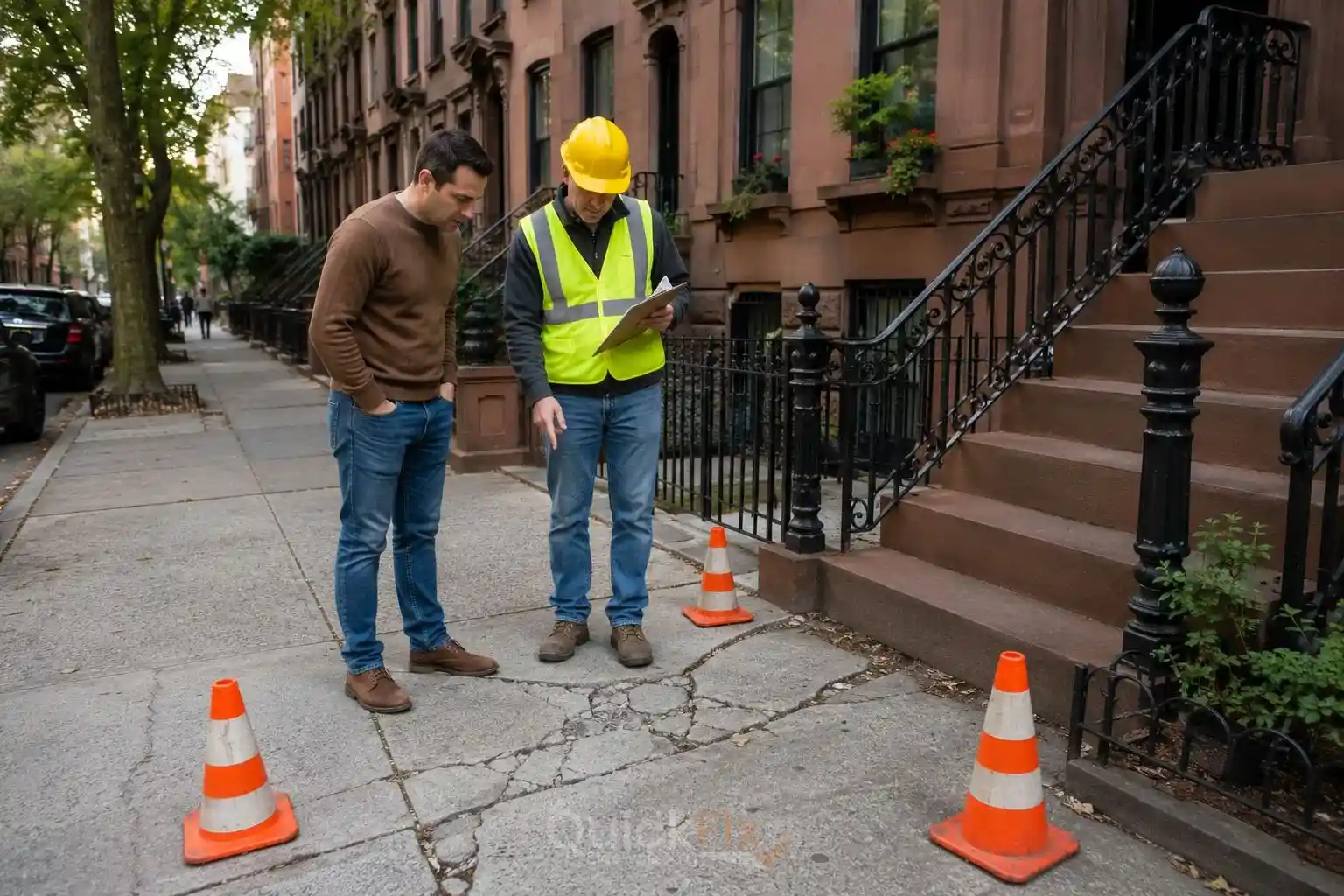
Quick Answer: The property owner is responsible for sidewalk repair in NYC under NYC Administrative Code §19-152. Even though the city owns the land underneath, property owners are responsible for maintaining safe conditions and paying for repairs.
The Basic Rule: Who's Responsible for Sidewalk Repair in NYC?
The property owner is responsible for fixing NYC sidewalks under NYC Administrative Code §19-152. That rule catches a lot of people off guard, especially first-time homeowners who assume the sidewalk is city property from curb to curb, in every sense. It isn't. The city owns the land underneath it, sure, but the second that concrete cracks, heaves, or turns into a tripping hazard, it's your name attached to the fix, not the Department of Transportation's.
It's a rule that trips people up (pun intended) because it feels backwards. You didn't pour that concrete. You don't drive on it. Yet if a delivery driver rolls an ankle on a lifted slab in front of your building, you could be the one covering medical bills, not the city. That's where Section 7-210 of the Administrative Code comes in: it puts the liability for injuries squarely on the property owner if the sidewalk wasn't kept in a reasonably safe and accessible condition. Combine that with §19-152, and you've got the two rules that quietly run New York's entire sidewalk system: you own the risk, and you own the repair.
Skip the fix, and it doesn't just sit there as a hypothetical fine. It turns into an actual bill, often a steep one, because the city isn't shopping around for the best contractor rate when it does the job for you.
Is the City Responsible for Sidewalk Repair?
Yes, but only under limited circumstances. The city is responsible for sidewalk repair only when an owner ignores a violation or the damage becomes an emergency, and even then, the city bills the owner afterward. So "the city will fix it" isn't the relief it sounds like. It's closer to a collections process with a jackhammer.
Here's how it typically plays out: DOT flags the sidewalk after a thorough inspection and issues a violation notice if a hazardous condition is found. The owner gets 75 days to resolve the damage, and if nothing happens within the given deadline, the city brings in its own crew. The invoice that follows usually runs higher than what a private contractor would have charged, because emergency city contracts aren't priced for bargain-hunting.
The One Exception: City Tree Root Damage
There is one real exception when the city pays for sidewalk repair, and it's worth knowing if you own a small home: the Trees & Sidewalk Program, sometimes called the Tree-Related Sidewalk Repair Program. If you own a one-, two-, or three-family home and a city-owned street tree is responsible for lifting your sidewalk, NYC Parks will repair it at no charge. It exists because root damage from city trees is genuinely not the homeowner's fault, and it would be unreasonable to bill someone for a problem the city's own landscaping caused.
A few conditions worth flagging before you assume you qualify for that program:
- Damage from anything other than city tree roots, like age, water intrusion, or soil settling, is on you, not the program
- Renting out part of the home can knock you out of eligibility entirely
- Confirming eligibility or submitting a request means calling 311 or going through the NYC Parks Department directly
Who Pays for Sidewalk Repair: Different Property Types
Whose Responsibility Is Sidewalk Repair at Rental Properties?
Owners of rental buildings and commercial properties pay for all sidewalk repairs themselves, with no city-funded exceptions. The Trees & Sidewalk Program mentioned above only covers small, owner-occupied 1-, 2-, or 3-family homes, so if you're running a multi-family building with 4 or more units, a commercial storefront, or an apartment complex, that free-repair door is closed to you regardless of who owns the tree overhead.
DOT doesn't wait for complaints, either. Inspectors move through all five boroughs on a rolling basis, and once a violation notice lands, the clock starts on a 75-day window. Miss it, and the city doesn't just fix the sidewalk and forget about it. The repair cost gets attached to your property as a tax lien, which follows the property and can complicate a sale or refinance long after the concrete's already patched.
The math tends to favor acting early. A same-day patch job from a private contractor is almost always cheaper than a DOT-ordered emergency repair, and it removes the liability exposure that comes with a known hazard sitting unrepaired.
Who Is Responsible for Sidewalk Repair at Condo and Co-op Buildings?
In front of a condominium, the condo association is responsible for sidewalk repairs, and in co-ops, that responsibility belongs to the co-op board. The split sounds like a technicality, but it changes who actually writes the check. Condo repairs are usually paid out of the association's operating budget or a special assessment voted on by unit owners. Co-op boards typically fund the same work through monthly maintenance fees, since sidewalks fall under "common areas" alongside the roof, lobby, and elevators.
Either way, the board is on the hook to:
- Keep the sidewalk in reasonably safe condition, not just eventually repaired, but maintained on an ongoing basis
- Replace or repair broken sidewalk flags before DOT flags them first
- Clear snow and ice promptly once winter weather hits
- Carry liability insurance that actually covers a slip-and-fall claim tied to the sidewalk
Hiring a super, a property manager, or an outside contractor to physically do the work doesn't shift the legal responsibility. If someone gets hurt because the board dragged its feet, the building itself can be named in the resulting claim, even if it has insurance.
Are Tenants Responsible for Sidewalk Repair?
Residential tenants are not responsible for sidewalk repairs, since that responsibility stays with the landlord. If you're renting an apartment, you can cross this one off your list entirely; NYC law puts the burden on the property owner, not the person paying rent.
Commercial tenants should read their lease before assuming the same protection applies to them. It's common for commercial leases to include a sidewalk maintenance clause requiring the tenant to keep the walkway swept, cleared of snow and debris, and free of damage caused by their own operations, think delivery pallets, forklifts, or dumpster drop-offs cracking the concrete. That clause doesn't usually extend to structural repairs, but it can make a tenant responsible for the everyday upkeep a landlord would otherwise handle. When the lease language is vague, asking the landlord directly beats guessing.
Special Sidewalk Repair Situations
Whose Responsibility Is Sidewalk Repair Near City-Owned Property?
Sidewalks next to city-owned property are maintained by whichever city agency owns that property, not by DOT by default. It's a detail that trips up a lot of people who assume DOT handles every public sidewalk. In practice, ownership of the adjacent building or land determines who's responsible:
- NYC Parks Department: sidewalks bordering parks and green spaces
- NYC Department of Education: sidewalks next to public schools
- NYCHA: sidewalks around public housing developments
- MTA or DOT: sidewalks near subway entrances and bridges
So a cracked sidewalk running along the edge of a city park isn't a DOT matter or a random neighbor's problem, but it's Parks' responsibility to repair, and reporting it to the wrong agency just slows things down.
Corner Lots & Sidewalk Repair Responsibility
Corner property owners are responsible for the sidewalks on both street frontages, not just the main one. It's easy to overlook the cross-street side of a corner lot, especially if the main entrance faces the other direction, but DOT doesn't grade corner properties on a curve. Both stretches of sidewalk get inspected, and both can generate separate violations if left unaddressed.
That doubled footprint also tends to double the paperwork. Repairing sidewalk on both frontages of a corner lot often means pulling multiple permits, particularly when work touches both streets at once, so it's worth budgeting extra time for approvals if you're planning repairs on a corner property.
Who Pays When Tree Roots Damage Your Sidewalk?
Whether you or the city pays for tree-related sidewalk damage depends on both tree ownership and property type, not just one or the other. Root damage is one of the most frequent causes of sidewalk cracking in NYC, and it's also one of the most misunderstood when it comes to who's responsible.
If the tree belongs to the city and the property is a one-, two-, or three-family owner-occupied home, NYC Parks typically covers the sidewalk repair at no cost. But that same city-owned tree causing damage to a multi-family residential property, commercial building, rental property, condo, or co-op doesn't trigger the same free repair. It means the ownership of the property decides who pays.
If you're unsure who owns the tree responsible for the damage, 311 can confirm it or schedule an inspection. And regardless of how frustrating a lifted sidewalk gets, never cut down or remove a city-owned tree without authorization. The fines for unauthorized removal are steep enough to make the sidewalk repair look cheap by comparison.
Key Takeaways: Sidewalk Repair Responsibility in NYC
The city owns New York's sidewalks on paper, but the responsibility for keeping them safe rests almost entirely with property owners. That responsibility isn't just about avoiding a violation notice or a lien on your taxes, either. It's about making sure the block outside your door doesn't become the reason someone gets hurt.
Here's who is responsible for sidewalk repair:
- Single-family homeowners: You pay (except city tree damage)
- Multi-family buildings (4+ units): Building owner pays
- Condo buildings: Condo association pays
- Co-op buildings: Co-op board pays
- Commercial properties: Property owner pays
- City-owned adjacent properties: The respective city agency pays
- Rental properties: Landlord/property owner pays
Regular inspections, quick repairs, and a clear understanding of who's responsible for sidewalk repair can spare you a lot of cost and hassle down the line.
Don't Know Who's Responsible? We Can Help
If you're dealing with a cracked, uneven, or crumbling sidewalk and aren't sure whose responsibility is sidewalk repair in your situation, you don't have to sort it out alone. Reach out to QuickFix Sidewalk NYC today for expert guidance on sidewalk responsibility and repairs.
We offer free estimates and consultations for property owners across all five boroughs, whether you're dealing with a single lifted slab or a full corner-lot replacement. Our experienced team handles everything from the initial assessment to final DOT sign-off, so the only thing you have to figure out is which afternoon works for the site visit.