Project Snapshot
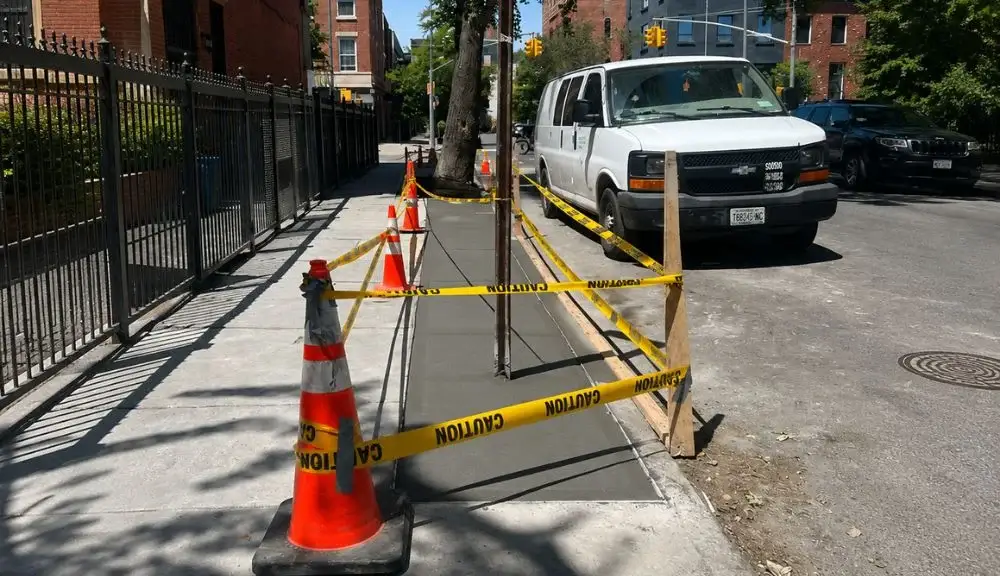
- Location: 32 Downing St. Brooklyn, NY 11238, USA
- Property type: Historic residential rowhouse (Clinton Hill Historic District)
- Issue: DOT violation / tree root damage from a mature street tree
- Scope: 13 flags / 325sq ft
- Permit(s): Sidewalk permits, Tree work permit, 811 Utility Mark-out Ticket, LPC permit
- Estimated cost: $6370+$140+$135=$6645
- Timeline: Approximately two days on-site and 60 days for official violation clearance
- How they found us: Referral from past customer
How This Customer Found Us
The homeowner at 32 Downing St., Brooklyn, was referred to us by a previous client who had gone through a similar sidewalk repair and spoke highly of how we managed permits and delivered DOT-compliant work from start to finish. Given that this property sits inside the Clinton Hill Historic District, the owner specifically wanted a contractor experienced with LPC approvals, not just standard sidewalk permitting. After discussing our track record with historic-district projects and tree-related sidewalk damage, they brought us on to manage the entire process to remove sidewalk violation.
The Problem
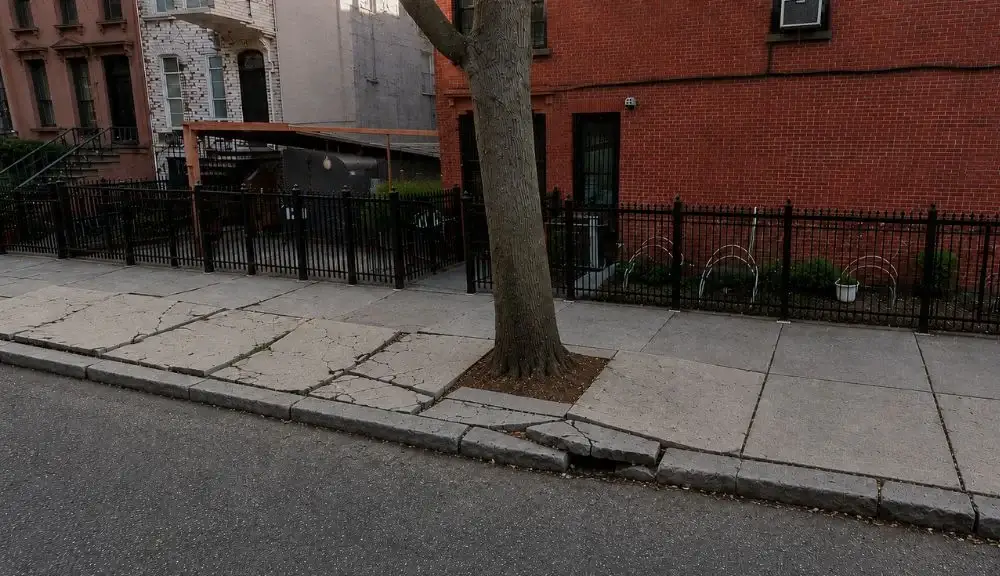
The sidewalk fronting this Clinton Hill rowhouse had been gradually damaged by a mature, city-owned street tree situated along the property line. Over the years, the expanding root system lifted and cracked the concrete across roughly 325 square feet, affecting 13 individual slabs. Because the property sits on a residential block with steady pedestrian traffic, including neighbors, delivery workers, and visitors to nearby brownstones, the uneven surface had become a genuine trip hazard.
As with any sidewalk fronting a private residence in NYC, NYC Administrative Code §19-152 places responsibility for safe sidewalk conditions on the property owner. But this property carried an added layer of complexity: because it falls within a designated historic district, any repair also had to satisfy the Landmarks Preservation Commission's requirements for preserving the visual character of the streetscape, on top of standard DOT construction rules and ADA accessibility standards.
During the assessment, our team also flagged some deterioration in the adjoining curb section. While curb condition technically falls outside a homeowner's obligations and remains the city's responsibility, NYC DOT encourages owners to address curb repairs alongside sidewalk work whenever the two meet at a shared edge. A stable, well-maintained curb helps anchor the new sidewalk slabs and reduces the risk of edge settlement undermining the fresh concrete down the line. The homeowner opted to move forward with the curb repair at the same time.
Site Assessment
Our inspection confirmed the sidewalk damage was rooted in active growth from the adjacent city tree rather than general age-related settlement. Heaving was concentrated along the root path nearest the tree pit, with cracking extending outward toward the curb. Because the tree was city-owned, any excavation near its root zone required sign-off from NYC Parks in addition to DOT approval.
Given the historic designation, we also had to account for how the finished sidewalk would look, not just how it would perform. LPC generally expects replacement materials, scoring patterns, and dimensions to closely match the surrounding historic streetscape, which meant this repair needed more upfront coordination than a typical residential sidewalk swap. With the curb repair added to the scope, our team also pulled the appropriate curb repair permit to keep that portion of the work fully authorized alongside the sidewalk.
Execution
Every historic-district sidewalk repair adds a layer on top of the usual three stages: assess and price, secure approvals, then execute. Here's how each stage played out at 32 Downing St.
Day 0–1: Inspection and Estimate
Our team walked the frontage and traced the damage back to the root system of the adjacent street tree. Since the surrounding blocks are lined with mature trees planted decades ago, this pattern is a familiar one in Clinton Hill. The estimate we prepared accounted not just for concrete replacement, but for the additional documentation and material specifications the LPC review would require, along with the curb work the homeowner chose to add.
Day 3–21: Permits, LPC Review, and Scheduling
Before any work could begin, our team filed for six separate approvals:
- Sidewalk Construction Permit: the baseline DOT authorization required for the repair
- Sidewalk Closing Permit: needed to close the work area safely during construction
- LPC Permit: required because the property sits within the Clinton Hill Historic District, and any exterior alteration visible from the street, sidewalks included, needs Landmark's sign-off
- Tree Work Permit: required from NYC Parks since the affected tree is city-owned
- Curb Repair Permit: pulled since the homeowner elected to repair the adjoining curb alongside the sidewalk, even though curb maintenance isn't a homeowner obligation under §7-210
- 811 Utility Mark-Out Ticket: submitted ahead of excavation to identify buried utility lines
The LPC review was the longest step in the process. Our team prepared documentation showing that the replacement slabs would match the existing scoring pattern, dimensions, and finish used throughout the historic block, while still meeting current DOT specifications. Once that documentation was submitted, approval came through without requiring revisions, and the remaining permits, including the curb repair permit, were processed in parallel.
Day 21–23: The Repair Itself
With every approval in hand, our crew moved efficiently through the physical repair:
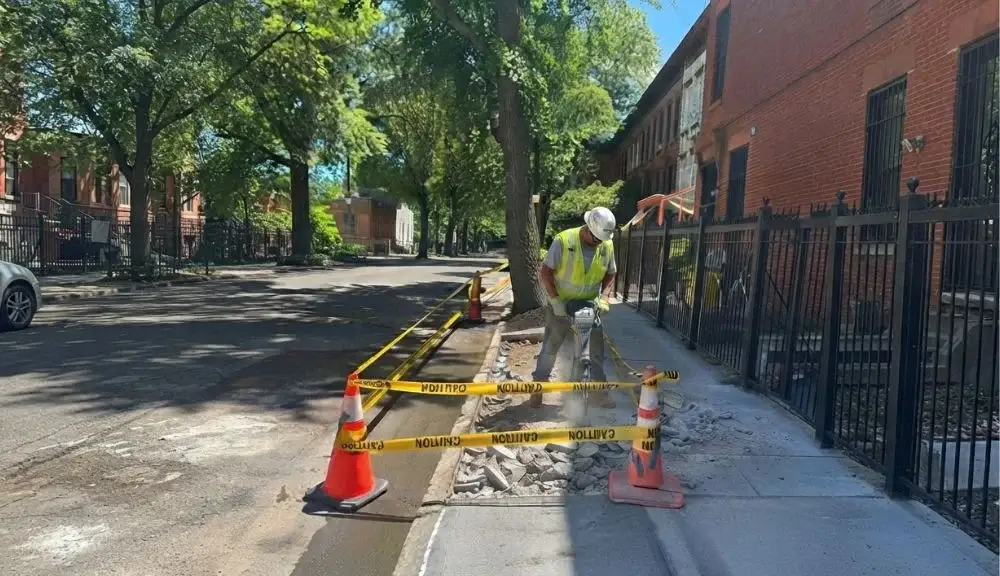
- Demolition: All 13 damaged slabs across the 325-square-foot frontage were broken out and removed, exposing the root system beneath. The deteriorated curb section was also broken out at this stage.
- Root management: Working within NYC Parks' guidelines noted on the tree work permit, our team coordinated root pruning that stayed within safe limits for the tree's health, relieving pressure on the sidewalk without destabilizing the root structure.
- Root barrier installation: A subsurface root barrier was installed along the frontage to redirect future root growth away from the new slabs.
- Base preparation: The subgrade was regraded and compacted to provide a stable, level base for the new concrete, including the section beneath the repaired curb.
- Curb repair: The adjoining curb was rebuilt using DOT-spec concrete, giving the new sidewalk a solid, well-anchored edge instead of leaving it to meet a deteriorating curb line.
- Historic-match concrete pour: New slabs were poured using DOT-compliant, fiber-reinforced concrete, finished with a scoring pattern and dimensions matched to the surrounding historic sidewalk to satisfy LPC preservation requirements.
- Finishing and cure time: Slabs and curb were finished to grade and allowed to cure fully before reopening the sidewalk to pedestrian traffic.
Throughout the project, the crew maintained a safe pedestrian path around the work zone, since the block sees regular foot traffic from residents and visitors moving between nearby brownstones.
Day 23–45: Final Inspection and Compliance
Once the new slabs and curb cured, we coordinated the final DOT inspection on the homeowner's behalf. Our team stayed engaged through the inspection process, ready to address any adjustments at no additional cost if DOT had requested them. The repair passed inspection on the first attempt, bringing the property into full compliance with DOT standards, LPC preservation requirements, and curb condition guidelines, closing out the matter without further city involvement.
Cost Breakdown
- Sidewalk Construction Permit: $70
- Sidewalk Closing Permit: $70
- Tree Work Permit: Free
- 811 Ticket: Free
- LPC permit: Free
- Curb repair permit: $135
- Construction (500 sq. ft. @ $13/sq. ft.): $6370
- Total: $6645
Results
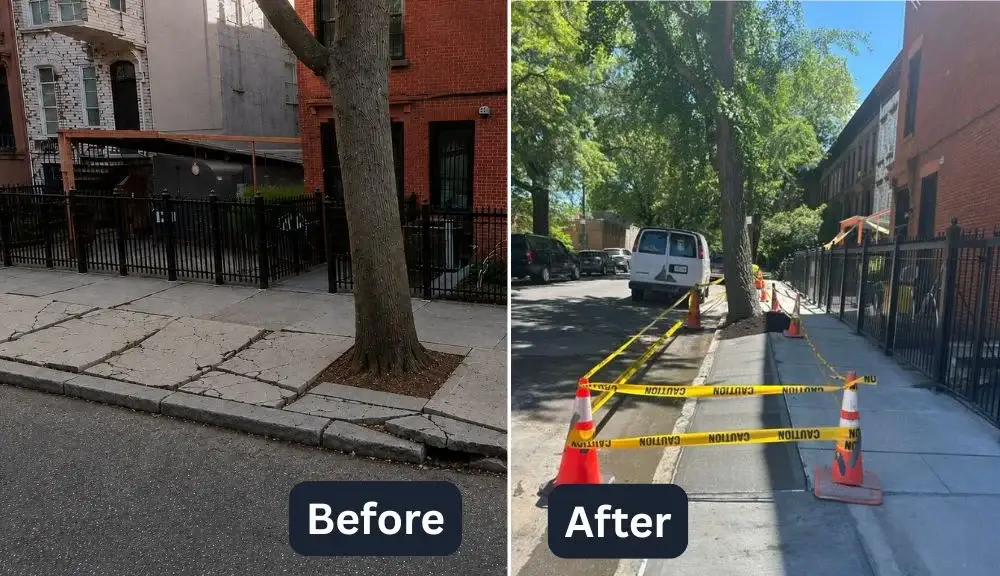
All 13 damaged slabs across the 325-square-foot frontage were replaced, eliminating the trip hazard created by root intrusion while satisfying LPC's requirements for preserving the historic streetscape. The adjoining curb was also rebuilt, giving the new sidewalk a stable, well-anchored edge and reducing the risk of future settlement at that junction. The new ADA-compliant walkway relieves ongoing root pressure at the original failure points, reducing the likelihood of renewed heaving in the near term.
Client Testimonial
"I was honestly worried the historic district rules would turn this into a months-long headache. They handled the LPC paperwork along with everything else and even suggested fixing the curb at the same time so it wouldn't undermine the new sidewalk later. The new sidewalk actually looks like it belongs on the block. Passed inspection the first time, no surprises. Really grateful to my neighbor for the referral and to this team for making the whole thing so easy."
(Homeowner, Clinton Hill, Brooklyn)
Why Clinton Hill and Historic Brooklyn Homeowners Choose Us
Brooklyn's historic districts, Clinton Hill included, combine two challenges that don't usually overlap: decades-old street trees with expansive root systems and Landmarks Preservation Commission oversight that governs how repairs can look. We've built our permitting process around handling both at once, along with related items like curb condition, so homeowners aren't stuck coordinating between DOT, NYC Parks, and LPC on their own. That means fewer delays, fewer resubmissions, and a sidewalk that satisfies the city while fitting the character of the block.
We also have a proven record right in this neighborhood, having restored a sidewalk nearby, and it was seeing that result firsthand that led the owner to refer us for this project. It's easy to trust a contractor blindly when you've already seen the result with open eyes.