Project Snapshot
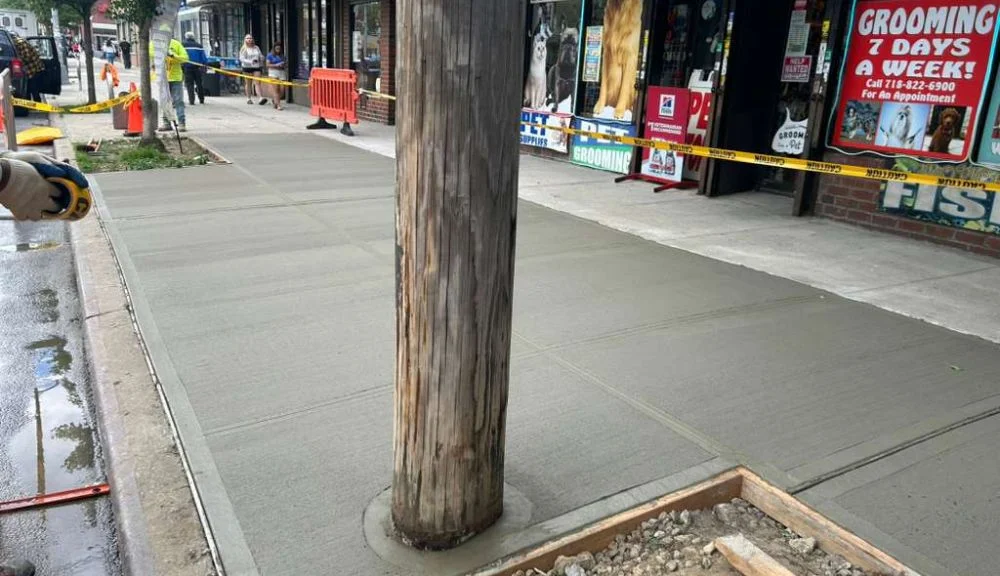
- Location: 1626 Crosby Avenue, Bronx, NY 10461, USA
- Property type: Mixed-use (Commercial storefront with residential occupancy above)
- Issue: DOT violation / tree root damage from two mature trees
- Scope: 20 flags / 500sq ft
- Permit(s): Sidewalk permits, Tree work permit, 811 Utility Mark-out Ticket
- Estimated cost: $6500+$140 = $6640
- Timeline: Approximately two days on-site and 60 days for official violation clearance
- How they found us: Google search
How This Customer Found Us
The owner of Crosby Pet Center found us through a Google search shortly after discovering a NYC DOT sidewalk violation notice attached to the storefront. Although the sidewalk damage had gradually worsened over time, the notice made it clear that repairs could no longer be delayed. With two mature street trees lifting and cracking the concrete directly outside the business entrance, the owner needed a licensed Bronx sidewalk contractor who could handle the entire process, from permits and utility coordination to a DOT-compliant repair. After reviewing our experience with sidewalk violations and tree root damage, they contacted us for a free on-site inspection.
The Problem
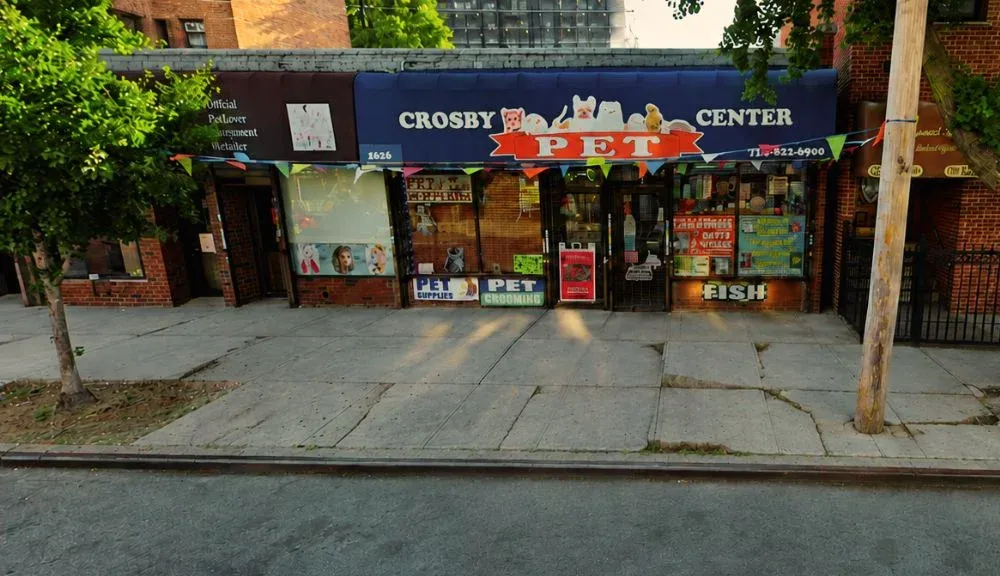
The sidewalk fronting Crosby Pet Center had been steadily compromised by root growth from two large, mature street trees positioned on either side of the property frontage. As the root systems expanded beneath the concrete over time, they pushed multiple slabs upward, cracked others, and left the surface uneven across roughly 500 square feet, about 20 individual sidewalk slabs.
For a commercial storefront with steady foot traffic, this created two compounding problems: a real trip-and-fall risk for customers and pedestrians and mounting liability exposure for the property owner. Under NYC Administrative Code § 7-210, property owners bear responsibility for maintaining the sidewalk in a reasonably safe condition, which means the exposure sits squarely with the owner until the repair is made.
Site Assessment
On inspection, our team confirmed the damage pattern was consistent with active root intrusion rather than settlement or age-related wear. The telltale signs were localized heaving directly above root lines, with cracking radiating outward from those lift points. Both trees had root systems mature enough that any repair needed to account for continued growth, not just the current damage.
Because the work involved excavation near street trees and required coordination around utility lines, the scope called for more than a standard slab swap: it required a Tree Work Permit alongside the standard sidewalk permits, plus an 811 utility mark-out to safely locate underground infrastructure before any excavation began.
Execution
Every sidewalk repair really happens in three stages, and this one was no different: get eyes on the damage and price it out, get the paperwork moving, then get the crew on-site to actually fix it. Here's how each stage played out at Crosby Pet Center.
Day 0–1: Inspection and Estimate
Once our team walked the frontage, the pattern was easy to read. The heaving wasn't random, it lined up almost exactly with the root paths running out from both street trees, which told us this was active root intrusion, not just old concrete giving out from age. That distinction matters, because it changes the whole scope of the fix. A slab swap alone would've bought maybe a season or two before the same roots pushed the new concrete right back up. So the estimate we put together covered root management up front, not just a pour-and-go replacement.
Day 3–14: Permits and Scheduling
With the scope locked in, we filed for all four permits this project needed before a single tool touched the sidewalk:
- Sidewalk Construction Permit: the baseline authorization to legally perform the repair
- Sidewalk Closing Permit: needed to close off the work zone during construction
- Tree Work Permit: required any time excavation comes near a street tree's root zone, which both trees here definitely qualified for
- 811 Utility Mark-Out Ticket: submitted ahead of excavation so utility companies could flag buried gas, water, electric, and telecom lines using standard color codes
That mark-out step isn't just a formality. On a block like Crosby Avenue, where multiple utility lines often run close together near commercial storefronts, knowing exactly where they sit before digging is what keeps a root-removal job from turning into a utility repair job. Permits came back quickly enough that construction was able to start after approval, tight but workable, since the paperwork was already lined up before the crew was scheduled.
Day 14–16: The Repair Itself
This is where the real work happened, and it went well beyond removing broken concrete:
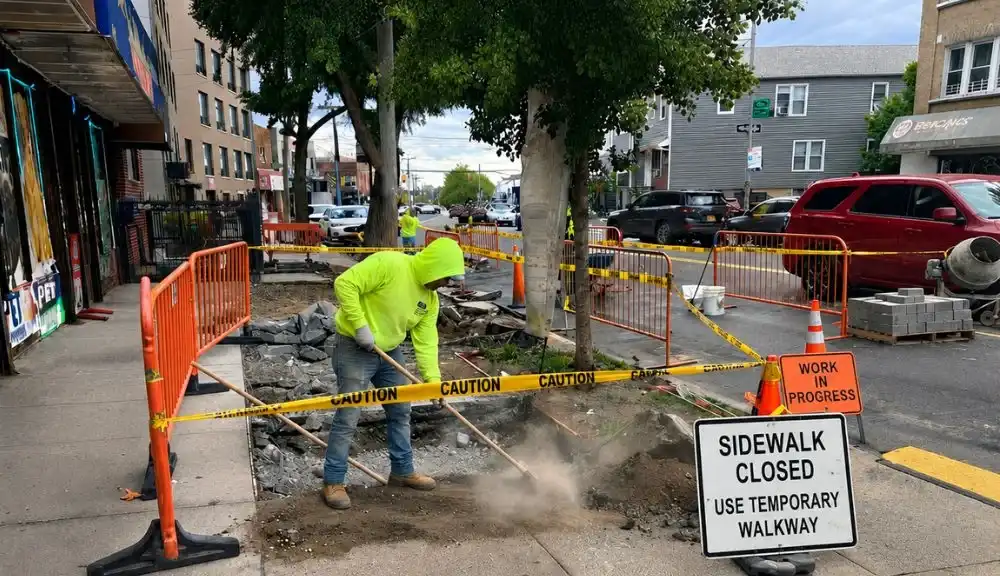
- Demolition: All 20 affected slabs across the roughly 500-square-foot frontage were broken out and hauled off, clearing the way down to the root systems themselves.
- Root pruning: Rather than leaving the roots to keep pushing against whatever went back down, we coordinated with a licensed arborist as per NYC Parks' instructions, mentioned on the tree work permit, to selectively prune (no more than 25% of each tree's roots) the intruding roots from both trees. This is a careful process; prune too aggressively and you risk destabilizing a mature tree, or prune too little and the problem just resurfaces in a year or two. The goal is always to relieve the pressure on the slab without harming the tree itself.
- Root barrier installation: Once the roots were managed, we installed root barriers along the property frontage. Think of these as a subsurface fence: they redirect future root growth downward and away from the new concrete instead of letting roots creep right back up into the slab joints the way they did the first time around.
- Base preparation: With the roots addressed, the subgrade was regraded and compacted to give the new concrete a stable, even foundation instead of pouring over the same uneven ground that caused the original heaving.
- Fiber-reinforced concrete pour: For the new slabs, we used fiber-reinforced air-entrained 4000 PSI ready-mix concrete. The embedded fibers distribute stress across the slab instead of letting it concentrate at a single crack point, which makes a real difference on a storefront sidewalk that sees steady foot traffic day in and day out and gives the surface added resistance if any residual root pressure does build up over time.
- Finishing and cure time: Slabs were finished to grade and left to cure properly before the work zone opened back up to full pedestrian use.
Throughout, the crew kept a safe path open around Crosby Pet Center's entrance, since a pet store depends on steady walk-in traffic, including plenty of customers walking dogs right past the work zone. The project wrapped on an efficient timeline, with the sidewalk, the storefront, and the surrounding block all back to normal without the kind of prolonged disruption that longer root-related jobs can sometimes bring.
Day 16 – Day 60+: Final DOT Inspection and Compliance
Pouring the concrete is only half the job. The part that actually closes out a violation is the inspection, so once the new slabs had cured, we coordinated the final DOT inspection directly on the property owner's behalf, one less thing for a business owner running a storefront to have to chase down.
Our team stayed involved through the entire inspection process, not just to hand the work over and walk away. If DOT had come back with any adjustments like a slab that needed re-grading or a joint that needed correcting, we were on standby to handle it at no additional cost to the owner. That's the kind of thing that only comes up after the fact, so it's worth having covered rather than assumed.
As it turned out, none of that was needed. The repair passed on the very first inspection, the violation was officially dismissed, and 1626 Crosby Avenue was brought back into full compliance, closing the loop from a DOT-flagged trip hazard to a clean, code-compliant sidewalk without a second round of paperwork or a second visit from the city.
Cost Breakdown
- Sidewalk Construction Permit: $70
- Sidewalk Closing Permit: $70
- Tree Work Permit: Free
- 811 Ticket: Free
- Construction (500 sq. ft. @ $13/sq. ft.): $6500
- Total: $6640
Results
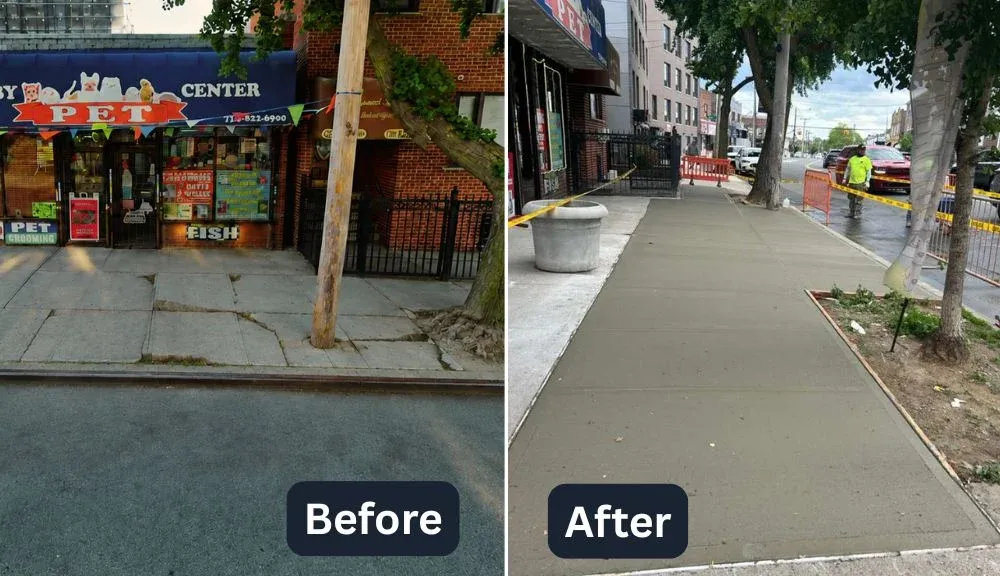
The full 500-square-foot section, or all 20 affected slabs, was removed and replaced, eliminating the trip hazards created by root intrusion and bringing the frontage back into compliance with the property owner's maintenance obligations under § 7-210. The repair also relieved the pressure points where root growth had been actively lifting the concrete, reducing the likelihood of the same damage reappearing in the same spots in the near term.
Client Testimonial
"Honestly, I was just relieved it's finally fixed. That sidewalk had been a headache for months. I kept worrying someone was going to trip walking into the store. When DOT came back and said it passed on the first try, that was a huge weight off. I didn't have to deal with any of the permit stuff myself; they just handled it. Highly Recommended."
(Owner Crosby Pet Center, Bronx)
Why Bronx Homeowners and Business Owners Choose Us
Bronx properties see some of the highest rates of tree-root sidewalk damage in the city, simply because so many blocks, Crosby Avenue included, were planted with mature street trees decades ago, long before root systems reached their current size. That means we see this exact failure pattern often, and we know how to scope it correctly the first time instead of repouring concrete that root growth will just lift again in a few years. We also work efficiently to keep project costs aligned with what price-sensitive Bronx property owners and small business tenants need, without cutting corners on permits or materials.