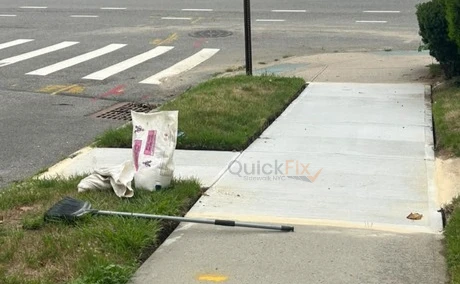
If you own property in New York City, the concrete in front of your building is one of the few things you are legally responsible for that you do not actually own.
The City owns the sidewalk. You pay to fix it. You pay when someone falls on it. And since 2003, you are the one named in the complaint.
Most owners learn this the hard way: a certified letter from the Department of Transportation, a 75-day clock they did not know had started, or a notice of claim that lands eighteen months after a fall nobody told them about. By then the cheap options are gone.
Here is the part almost nobody reports. Between fiscal year 2014 and fiscal year 2023, the number of sidewalk injury claims the City of New York settled each year fell by 28%. Over the same period, the average cost of each settled claim rose 114%, from roughly $52,400 to roughly $112,300. Fewer cases. Far more money per case. That is the whole risk picture in one line, and it is why a half-inch of concrete deserves more of your attention in 2026 than it did five years ago.
This guide assembles the numbers that actually matter, pulled from the NYC Comptroller's Annual Claims Report, DOT's own property owner guidance, the Administrative Code, New York Court of Appeals decisions, and current 2026 contractor pricing. Every figure is sourced, with links at the end.
Part 1: The Scale of the Problem
-
New York City has more than 12,000 miles of sidewalk
NYC DOT states the figure as "over 12,000 miles." The more precise number that circulates in City documents and press coverage is 12,750 miles, enough, as Mayor Bloomberg noted when the liability law passed, to stretch roughly halfway around the world.
That length is the reason the law works the way it does. It is also the reason it will not be changing back.
-
The city repairs less than 1% of its sidewalk area each year
DOT's Sidewalk Repair Program replaces more than 2 million square feet of sidewalk annually, a large program by any standard. But DOT states plainly in its own property owner guide that this "amounts to less than 1% of the city's total sidewalk area a year. DOT relies on property owners to maintain the rest."
That single sentence is the whole policy in miniature: the city maintains a rounding error, and 99%+ falls to private owners.
-
About two-thirds of NYC's sidewalk area sits in front of 1-, 2-, and 3-family homes.
A DOT sidewalk management presentation breaks the city's sidewalk area down as roughly:
-
1-, 2-, 3-family properties: ~440.3 million sq ft (67%)
-
4-plus-unit properties: ~193.3 million sq ft (29%)
-
City-owned property: ~23.4 million sq ft (4%)
The City's own repair work focuses on city-owned property and on neighborhoods dominated by one-, two-, and three-family homes, which is to say, largely the properties that are exempt from the harshest liability provisions anyway.
If you own a commercial building, a mixed-use property, or a building with four or more units, the practical odds of the City fixing your sidewalk for you are close to zero.
4. Street trees are the single largest physical cause of sidewalk damage.
NYC Parks maintains roughly 700,000 street trees, and the city owns every one of them in the public right-of-way. Root growth lifts flags, cracks concrete, and creates precisely the vertical displacement that produces both violations and lawsuits. According to NYC Parks, tree root damage is linked to more than 50% of sidewalk repair requests citywide.
Part 2: The Law: Who Is Actually Liable
5. Liability shifted from the City to property owners on September 14, 2003
Administrative Code § 7-210, enacted as Local Law 49 of 2003, moved primary sidewalk tort liability from New York City onto the owner of the abutting property.
Before that date, a pedestrian who tripped on a broken sidewalk sued the City. After it, they sue the building owner. The New York Court of Appeals has described the purpose plainly: the City Council enacted § 7-210 to transfer tort liability from the City to adjoining property owners as a cost-saving measure.
This is the most consequential fact in this article and still the one most NYC owners do not know.
6. Three different code sections create three different obligations.
Owners routinely collapse these into one vague sense of "the sidewalk is my problem." They are separate laws doing separate jobs, with very different consequences:
|
Code Section |
Purpose |
Consequences of Breach |
|
§ 19-152 |
The duty of repairs. Defines what counts as defects |
DOT violation, city-performed repair, bill, lien |
|
§ 7-210 |
Civil tort liability. Makes you the defendant |
Personal injury judgement or settlement |
|
§ 16-123 |
The snow and ice removal responsibility |
Fine, plus evidence of negligence in a lawsuit |
The critical distinction: a § 19-152 violation carries no fine at all. Liability under § 7-210 routinely runs into six figures. Owners consistently panic about the first and ignore the second.
7. The homeowner exemption is narrower than most people assume.
One-, two-, and three-family properties are exempt from § 7-210 liability, but only if the property meets all three conditions:
-
One, two, or three family homes
-
Owner-occupied in whole or in part
-
Used exclusively for residential purposes
Where owners get caught:
-
A three-family house with a ground-floor storefront is not exempt; the "exclusively residential" condition fails
-
A two-family house rented out entirely while the owner lives elsewhere is not exempt the owner-occupancy condition fails
-
Co-ops, condos, and any building with four or more units are not exempt
And even exempt owners still carry the duty to repair under § 19-152. The exemption removes the strict-liability standard, not the obligation. An injured pedestrian can still sue an exempt homeowner on ordinary negligence grounds.
8. The City still owns liability for certain sidewalks
The city retains responsibility for sidewalks abutting city-owned property such as public buildings, precincts, and firehouses; sidewalks in and around public parks; and highway-adjacent walkways.
For those claims, an injured party must file a Notice of Claim within 90 days under General Municipal Law § 50-e, then commence suit within one year and 90 days, and must generally prove the City had prior written notice of the defect.
9. Property owners have four hours to clear snow, and the clock pauses overnight
Under § 16-123, snow and ice must be removed within four hours after snow stops falling, with the period between 9:00 p.m. and 7:00 a.m. excluded from the count. In practice:
-
Snow stops at 2:00 p.m. → clear by 6:00 p.m.
-
Snow stops at 6:00 p.m. → three hours run, then the clock pauses at 9:00 p.m.; the balance is due shortly after 7:00 a.m.
-
Snow stops at 3:00 a.m. → clear by 11:00 a.m.
Where ice is frozen too hard to remove without damaging the pavement, the owner must spread sand, ashes, sawdust, or similar material, then clear it fully when weather permits. Owners in Queens and Staten Island with 500 or more linear feet of frontage need only begin within the four hours and complete within a reasonable time.
10. The snow ticket is trivial. The negligence inference is not.
DSNY can issue penalties for failing to clear, and the City can perform the removal itself and charge the cost back through the owner's taxes.
But the fine is not the exposure. A § 16-123 violation is admissible as evidence of negligence in a personal injury lawsuit. A plaintiff's attorney who can put a sanitation summons and a timestamped weather report in front of a jury has done most of the work of establishing that you failed to act reasonably. Document your snow removal, photos with timestamps, contractor invoices, and a written log. It is nearly free, and it is the cheapest litigation defense you will ever buy.
Part 3: Violations and Enforcement
11. A sidewalk violation carries no fine, which is exactly why owners ignore it
DOT is explicit: "There is no fine associated with a violation." It is a notice, not a ticket.
What it does instead is arguably worse. A copy is filed with the County Clerk and remains on file until the City confirms satisfactory repairs. It appears in title searches. It can complicate or kill a sale or refinance, usually discovered by a title company days before a closing, when the owner has the least leverage and the least time.
12. You get 75 days, and the clock starts on delivery, not on the date printed on the notice
The 75-day period begins when the notice is received, as shown on the certified mail receipt. If certified delivery fails, DOT mails it by regular mail and posts it on the property, and the posting date starts the clock.
Two things owners consistently get wrong:
-
Weather is not an excuse. DOT's position is that a contractor should be scheduled to begin as soon as weather permits. The 75-day period is identical year-round.
-
Pulling a permit does not extend the deadline. DOT states this directly in its guidance.
13. Immediately dangerous conditions get 10 days, not 75
Where DOT has been notified in writing of a defect and determines it constitutes an immediate danger to the public, it may direct the owner to repair within 10 days of service of the notice.
14. Every numbered flag on the Preliminary Inspection Report must be replaced, not patched
The PIR sketch accompanying a violation numbers each defective flag. All of them must be replaced in full. DOT additionally recommends replacing "free-standing" flags marked 6B, flags that become unattached once the adjacent defective flags come out. Note also that if you accumulate multiple violations over time, the newest supersedes all previous notices.
15. You can dispute a violation, and the re-inspector never sees the first report
Owners may request a re-inspection within 75 days by calling 311 and asking for "Dispute New Sidewalk Violation—Re-Inspection Request."
The re-inspection is performed by a different inspector who has no access to the original PIR and who files an independent report within the next 180 days. DOT notifies the owner at least five days before the re-inspection date, and inspectors are prohibited from knocking on the owner's door.
This is a real, meaningful remedy, and it is badly underused.
16. If you do not repair, the City does, and attaches a lien
Miss the 75 days and DOT may perform the work or assign one of its contractors. The Department of Finance then issues a bill and places a monetary lien against the property. You have 90 days to pay before interest accrues. Payment plans are available through Finance Business Centers.
Two mitigating details worth knowing: you are only billed for the defective flags actually replaced, and any flag marked with an "X" on the PIR may qualify for replacement free of charge.
17. A sidewalk repair permit costs $70 per 300 linear feet
That fee covers the administrative cost plus the dismissal inspection. Corner properties and through lots may require multiple permits. Homeowners performing their own work may apply by mail; contractors must apply through nycstreets.net.
When the work is finished, call 311 and request a "Sidewalk Violation Dismissal." An inspector verifies the work and the violation is cleared from the County Clerk's file. Until that happens, the violation is still sitting there waiting for your next title search.
Part 4: What Sidewalk Injuries Actually Cost
18. The City alone paid $53.5 million on sidewalk claims in FY2023 and nearly $488 million over a decade
From the NYC Comptroller's Annual Claims Report:
|
Fiscal Year |
Claims Filed |
Claims Settled |
Paid Out |
|
2014 |
2530 |
658 |
$34.5M |
|
2015 |
2560 |
661 |
$39.5M |
|
2016 |
2390 |
666 |
$32.1M |
|
2017 |
2347 |
762 |
$52.4M |
|
2018 |
2300 |
559 |
$47.3M |
|
2019 |
2275 |
562 |
$41.7M |
|
2020 |
2005 |
628 |
$54.6M |
|
2021 |
2135 |
581 |
$34.5M |
|
2022 |
2141 |
532 |
$34.5M |
|
2023 |
2350 |
476 |
$34.5M |
|
Total |
23033 |
6085 |
$487.9M |
Essential context: These figures cover only claims against the City of New York. They exclude the far larger universe of claims filed against private owners under § 7-210, which settle confidentially and appear in no public dataset.
In other words, the nearly half a billion dollars above is the smaller half of the picture. Nobody knows the size of the larger half.
19. Claim severity has more than doubled in ten years
This is the trend that matters most and the one no competing analysis is running:
-
FY2014: 658 settlements ÷ $34.5M = ~$52,400 average
-
FY2023: 476 settlements ÷ $53.5M = ~$112,300 average
A 114% increase in average cost per settled sidewalk claim, while the number of claims resolved fell 28%. Claim frequency is essentially flat across the decade. Claim severity is not.
Medical cost inflation, larger verdicts, and more aggressive plaintiff-side litigation funding are all plausible drivers. Whatever the cause, the direction is unambiguous, and it applies to private defendants at least as much as to the City.
20. Sidewalk claims were the 5th costliest personal injury category against NYC in FY2023
The five costliest FY2023 personal injury claim types by payout:
-
Motor vehicle = $173.7M
-
Civil rights = $145.4M
-
Police action = $93.1M
-
School accident = $70.6M
-
Sidewalk = $53.5M
Wrongful convictions, police misconduct, municipal fleet crashes, and then cracked concrete. For a hazard that is physically a half-inch of displacement, that is remarkable company.
21. DOT is consistently among the three most-sued agencies in New York City
In FY2023, DOT had 4,296 tort claims filed against it, third behind only the NYPD and the Department of Correction, and paid $91.2 million across 845 settlements.
The trend inside those numbers is the real story:
-
Average DOT settlement, FY2016: $58,959
-
Average DOT settlement, FY2023: $107,981, an 83% increase
-
Median DOT settlement, FY2023: $30,000
-
Total DOT tort payouts, FY2024: $115.27 million
22. Typical payouts cluster well below the headline figures
An analysis of NYC Comptroller sidewalk-claim data for FY2016–FY2023, published by the Orlow Firm, found the following distribution of City sidewalk payouts:
|
Percentile |
Payout |
|
Median |
$35000 |
|
75th percentile |
$95000 |
|
90th percentile |
$212,500 |
|
Maximum |
$4250,000 |
Queens ran below the citywide figure, with a $25,000 median versus $35,000 across the five boroughs.
Two caveats worth stating plainly. This is a plaintiff's firm's analysis of public data rather than a City publication, and it reflects city payouts only. Private-owner settlements are not captured. Still, the shape of the distribution is instructive: most claims resolve modestly, and a small tail of catastrophic cases drives the dollars.
23. Where claims come from: NYC tort filings by borough, FY2023
The Comptroller reports tort claims by borough. These cover all tort claims, not sidewalk claims specifically, but the geographic pattern is useful context for owners with multi-borough portfolios:
|
Borough |
Personal Injury Claims |
Property Damage Claims |
Total |
Total per 100k residents |
|
Bronx |
6289 |
940 |
7229 |
533 |
|
Brooklyn |
4001 |
1253 |
5254 |
205 |
|
Manhattan |
3485 |
922 |
4407 |
276 |
|
Queens |
2489 |
1269 |
3758 |
167 |
|
Staten Island |
533 |
291 |
824 |
168 |
Important caveat, and one most write-ups omit: the Bronx figure is inflated because Rikers Island facilities sit in Bronx County, and correction-facility claims are filed there. The Comptroller states this directly. Do not read the Bronx number as a sidewalk risk signal.
24. Insurers now treat sidewalk defects as a near-zero-tolerance underwriting item
Insurance brokers serving NYC building owners report that sidewalk-related injuries have become the leading liability claim against New York City landlords and that sidewalk claim totals have surpassed fire and water losses, and that they are historically the two largest sources of claims.
The practical consequences owners are seeing:
-
Inspectors dispatched during new-policy underwriting and at renewal
-
Sidewalk repair required as a condition of binding or renewing coverage
-
What one broker characterizes as a "zero-tolerance policy" for unsafe conditions
This is attributed to underwriters via industry commentary rather than published loss data, so treat it as directional. But it matches what owners and managers report on the ground: the sidewalk is now something your carrier looks at, not just something DOT looks at.
Part 5: What the Courts Have Actually Decided
Three New York Court of Appeals decisions define the practical boundaries of § 7-210. Any owner or manager assessing sidewalk risk should know all three.
25. Tree wells are not part of the "sidewalk". Vucetovic v. Epsom Downs, Inc. (2008)
In Vucetovic v. Epsom Downs, Inc., 10 N.Y.3d 517 (2008), a pedestrian stepped into a tree well on East 58th Street and tripped on a cobblestone surrounding a tree stump. The Court of Appeals held that a tree well is not part of the "sidewalk" for purposes of § 7-210, reasoning that a statute in derogation of common law must be strictly construed.
The practical effect: where the injury-causing defect sits inside a tree well, the city remains the responsible party, subject to the prior written notice requirement. Where it sits in the adjacent sidewalk flag, the abutting owner is liable. The precise location of the fall determines who gets sued.
26. There is no bright-line "too small to matter" rule. Hutchinson v. Sheridan Hill House Corp. (2015)
In Hutchinson v. Sheridan Hill House Corp., 26 N.Y.3d 66 (2015), the Court of Appeals addressed three consolidated appeals in which defects had been dismissed as "trivial" before trial.
The holding matters for both sides. A defendant seeking dismissal on triviality grounds must make a prima facie showing that the defect is physically insignificant and that the characteristics of the defect and the surrounding circumstances do not increase the risk it poses. There is no minimum-dimension test. Courts apply a totality-of-the-circumstances analysis: width, depth, elevation, lighting, crowding, edge shape, and whether the defect is hidden.
On the specific facts in Hutchinson, a metal object protruding about a quarter inch above a well-lit sidewalk, standing alone, not jagged, surrounded by an even surface, was held trivial as a matter of law.
The lesson for owners is not "a quarter inch is safe." It is that a similar quarter-inch defect in poor lighting, on a crowded stretch, with a jagged edge or an uneven surround, may well reach a jury. The measurement alone decides nothing.
27. Your neighbor's defect can still be your problem. Sangaray v. West River Associates, LLC (2016)
In Sangaray v. West River Associates, LLC (N.Y. Court of Appeals, 2016), a single sidewalk flag ran across the frontage of two adjoining properties. The plaintiff's toe caught an expansion joint that abutted only the neighboring property. The lower courts dismissed the claim against the first owner on the basis that the defect was not in front of its building.
The Court of Appeals reversed. It held that the lower courts had wrongly read § 7-210 to impose a strict location requirement. A neighboring owner can be liable where its own failure to maintain its portion of the sidewalk contributed to the injury, here, where a substantial portion of the defective, sloping flag sat in front of that owner's property.
For anyone managing a building on a shared flag or at a property line, this is the case to know. "The crack is technically next door" is not a defense on its own.
28. A pending City Council bill would add $5,000 in civil penalties.
Int. 0195-2026, introduced January 29, 2026, by Council Members Oswald Feliz, Farah Louis, and Lynn Schulman, would amend § 19-152 to impose a civil penalty of up to $5,000 on property owners who:
-
Fail to complete repairs directed in a DOT violation order within the time specified, or
-
Fail to complete repairs directed by an immediate-danger notice within the time specified, or
-
Are issued an immediate-danger notice where DOT determines the owner knew or should have known the condition was an immediate danger, with the penalty applying immediately upon issuance, unless DOT finds the delay reasonable under the circumstances
The bill preserves the one-to-three-family owner-occupied exemption and would take effect 120 days after becoming law.
Status: referred to the Committee on Transportation and Infrastructure. An amended version, Int. 195-A, was proposed March 25, 2026. It is not law.
This is the forward-looking item that should be on every owner's radar. Under current law, ignoring a violation costs the repair plus interest. If Int. 195-A passes in its current form, it costs the repair, the interest, and up to $5,000, and the third provision creates exposure the moment a notice is issued, before any deadline has run.
Sources
NYC Department of Transportation
-
Sidewalks: https://www.nyc.gov/html/dot/html/infrastructure/sidewalkintro.shtml
-
NYC Sidewalks: A Property Owner's Guide to Address Sidewalk Defects (PDF), https://www.nyc.gov/html/dot/downloads/pdf/nyc-sidewalks-a-property-owners-guide-to-address-sidewalk-defects.pdf
-
Street Works Manual §4.6, Sidewalk Violation Inspections and Enforcement, https://streetworksmanual.nyc/chapter-four/sidewalk-violation-inspections-enforcement
NYC Administrative Code
-
§ 7-210, Liability of real property owner https://codelibrary.amlegal.com/codes/newyorkcity/latest/NYCadmin/0-0-0-4164
-
§ 16-123, Removal of snow, ice and dirt from sidewalks https://codelibrary.amlegal.com/codes/newyorkcity/latest/NYCadmin/0-0-0-26213
-
§ 19-152, Duties and obligations of property owner with respect to sidewalks and lots available in the same American Legal Publishing code library
NYC Comptroller
-
Annual Claims Report (FY2023 full text and detailed tables) https://comptroller.nyc.gov/reports/annual-claims-report/
-
Annual Claims Report FY2023 (PDF) https://comptroller.nyc.gov/wp-content/uploads/documents/Annual-Claims-Report-FY2023.pdf
-
Claims Dashboard (FY2024 data) https://comptroller.nyc.gov/services/for-the-public/claims-dashboard/overview/
-
File a Claim: https://comptroller.nyc.gov/services/for-the-public/claims/file-a-claim/
NYC Parks
-
Trees & Sidewalks Program https://www.nycgovparks.org/services/forestry/trees-sidewalks-program
-
Frequently Asked Forestry Questions https://www.nycgovparks.org/services/forestry/faq
-
Sidewalk Repair Claim Checklist (PDF) https://www.nycgovparks.org/pagefiles/176/nyc-parks-sidewalk-repair-claim-checklist__625713b285b75.pdf
Legislation
-
NYC Council, Int. 0195-2026 https://legistar.council.nyc.gov/LegislationDetail.aspx?ID=7861959&GUID=41C53199-FF19-49BD-BED7-168E9611FC06
Case law
-
Vucetovic v. Epsom Downs, Inc., 10 N.Y.3d 517 (2008) https://law.justia.com/cases/new-york/court-of-appeals/2008/2008-04901.html
-
Hutchinson v. Sheridan Hill House Corp., 26 N.Y.3d 66 (2015) https://nycourts.gov/reporter//3dseries/2015/2015_07578.html
-
Sangaray v. West River Associates, LLC (2016) https://law.justia.com/cases/new-york/court-of-appeals/2016/7.html
Open data and reporting tools
-
NYC Open Data, Sidewalk Management Database - Violations https://data.cityofnewyork.us/Transportation/Sidewalk-Management-Database-Violations/6kbp-uz6m
-
NYC311, Report Problems: https://portal.311.nyc.gov/report-problems/
Industry and secondary
-
City Building Owners Insurance Program, sidewalk liability, and underwriting https://citybuildingowners.com/blog/step-on-a-crack-break-your-mothers-bank-account/
-
The Orlow Firm, analysis of Comptroller sidewalk claim payouts https://www.orlowlaw.com/average-slip-and-fall-settlement-new-york
-
AEE Law, NYC sidewalk injury law https://aeelaw.com/insights/nyc-sidewalk-injury-laws/
-
AEE Law, FY2024 NYC claims analysis https://aeelaw.com/insights/nyc-claims-exposed/
-
CooperatorNews, historical coverage of Local Law 49 of 2003 https://cooperatornews.com/article/sidewalk-liability
-
Brick Underground, tree root sidewalk responsibility https://www.brickunderground.com/live/who-is-responsible-repair-fix-sidewalk-damage-tree-root-nyc
This article provides general information about New York City sidewalk regulations and is not legal advice. Administrative Code provisions, DOT procedures, and pending legislation are subject to change. Claims data reflects the most recent NYC Comptroller Annual Claims Report available at the time of writing. For guidance on a specific property or claim, consult a qualified New York attorney.