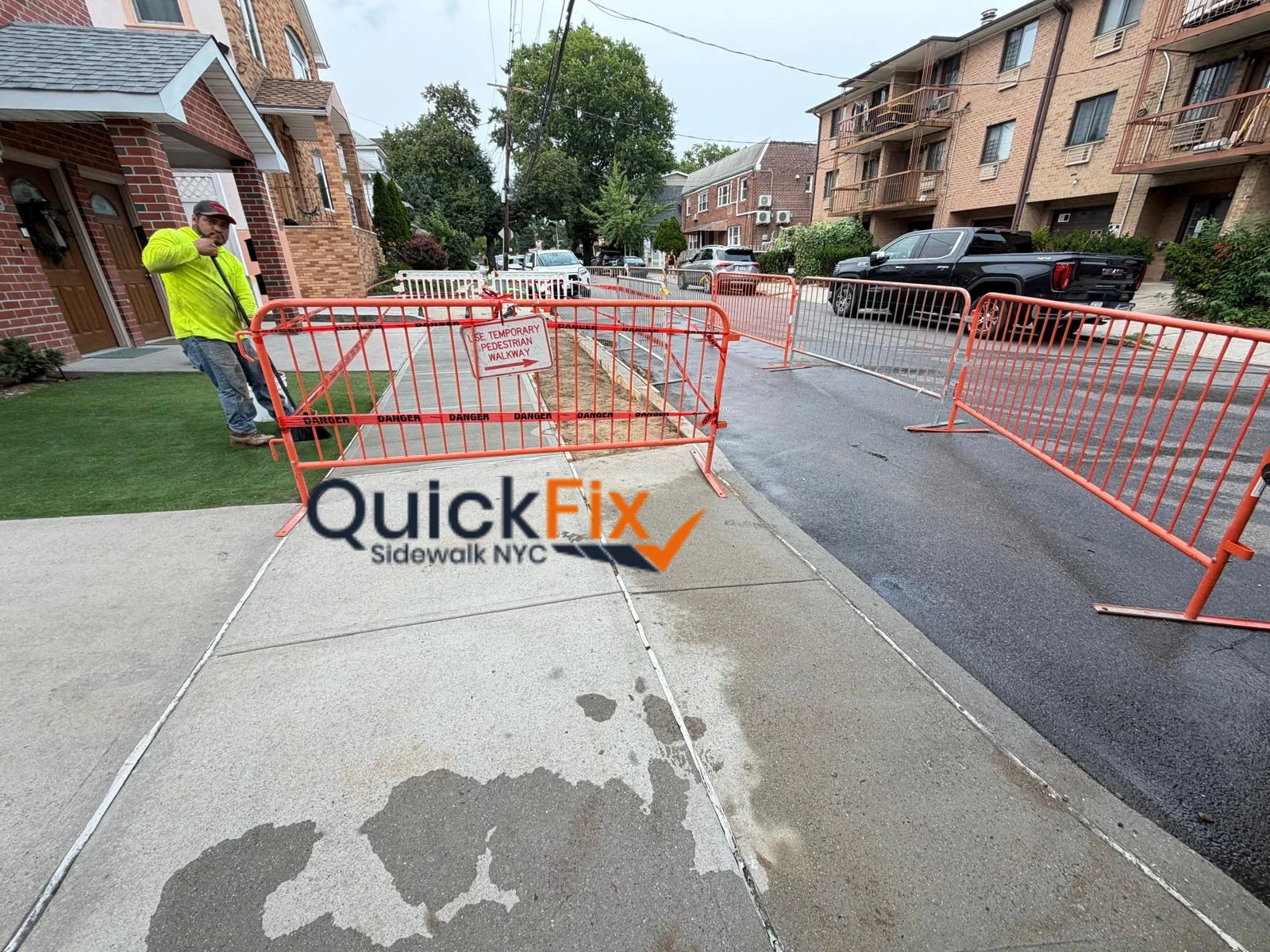
A New York City sidewalk violation does not clear the day your concrete cures. It clears when a DOT inspector walks the property, confirms the work matches the record, and the City notifies the County Clerk that satisfactory repairs were made. That makes your paperwork just as important as your pour. The process runs on five pieces of information you hand to 311, one sketch you need to read flag by flag, and a sidewalk clear enough that an inspector can see every square of it. Get those right, and the file closes. Get them wrong and you start over on a process that can stretch for months.
Know Which Inspection You Are Actually Asking For
Property owners use "reinspection" for two completely different requests, and asking for the wrong one is the fastest way to lose weeks.
The re-inspection, when you disagree with the violation
If the defects marked on your notice do not match what is in front of your building, you can request a re-inspection within 75 days of receiving the Notice of Sidewalk Violation. A second inspector goes out, and here is the part most owners miss: that inspector has no access to the first report. They are looking at your sidewalk cold. DOT schedules the visit within 180 days of the appeal and mails notice at least five days ahead.
Inspectors are prohibited from coming to your door during a re-inspection, so do not plan on making your case in person. Whatever is visible that day becomes the record, and the results arrive by mail. This is your final inspection.
The dismissal inspection, when the work is done
Once repairs are finished, you request a dismissal inspection instead. An inspector verifies the work was completed satisfactorily and, if it passes, DOT notifies the County Clerk so the violation comes off the property record. There is no fine attached to a sidewalk violation, but the copy filed with the Clerk stays there until the City says otherwise, and it can complicate a sale or a refinance.
The Five Pieces of Information 311 Will Ask For
NYC DOT lists exactly what you need in hand before you request a dismissal inspection:
• Permit number
• Property address
• Block and lot number
• Violation number
• Email address and phone number of the property owner
The phrasing matters too, because each request routes to a different queue. Ask for "Sidewalk Violation Dismissal Request - Work Done by Owner" if you handled the repair privately. To dispute a notice, ask for "Dispute New Sidewalk Violation - Re-Inspection Request." If you think the notice belongs to another building, ask for a "Sidewalk Violation Search." All of it runs through NYC 311.
Read the Preliminary Inspection Report Flag by Flag
The Preliminary Inspection Report, or PIR, is the sketch that arrives with your violation, and it is the most important document in the process. Every flag marked with a number on it has to be replaced and every defect corrected. Replacing four out of five numbered flags means a failed dismissal inspection.
A few details on the sketch are worth circling before anyone breaks concrete:
• Flags marked 6B are free-standing flags that come loose when the defective flags beside them are pulled. DOT recommends replacing these too, and skipping them often creates a fresh defect.
• Flags marked with an X may qualify for replacement at no charge if the City ends up doing the work. A Department of Design and Construction engineer makes that call at the time of construction.
• If you have received more than one notice, only the newest one counts. It supersedes every previous Notice of Sidewalk Violation on the property.
The PIR doubles as your evidence when the violation is not yours. Compare the width, the dimensions, and the placement of trees, signs, utility caps, and cellar doors. Those features are how you show the sketch describes a different building.
Your Permit Is Part of the Documentation
You cannot schedule a dismissal inspection without a permit number, so the permit is not optional paperwork. A sidewalk construction permit currently costs $70 for every 300 linear feet of sidewalk on any one property, and that fee covers the administrative cost plus sending an inspector out for the dismissal visit. Corner properties and through lots often need more than one.
Two things trip owners up. A permit does not extend your 75 days, which start when you receive the notice as shown on the certified mail receipt or on the posting date if the notice was posted instead. And if a contractor is doing the work, the contractor must pull the permit through nycstreets.net. Homeowners doing their own repairs can apply by mail with a signed Application for Roadway/Sidewalk Permit, a notarized Affidavit of Ownership, a stamped self-addressed envelope, and a certified check.
Write the violation number on the "For the Purpose of" line of the application. That single line is what ties your permit to the violation inside DOT's system.
Photograph Everything Before the Concrete Cures
Once new flags are poured, the evidence of what was underneath is gone. Build your own file as the work happens: dated photos of each numbered flag before demolition, shots of the subbase, shots of the finished pour, and a copy of the permit. If a question comes up later about what was replaced, that folder is the only version of events you control.
Pay attention to the conditions that legally define a defect under Section 19-152 of the Administrative Code, because those measurements are what the inspector checks against. Vertical differences of half an inch or more between adjacent flags count as a trip hazard, as does a surface defect an inch or greater across and half an inch deep. Full-depth cracks running joint to joint at a quarter-inch-wide or wider count. Hardware more than half an inch out of flush is a defect, and so are cellar doors that deflect more than an inch when walked on.
Expansion joints quietly sink a lot of dismissal inspections. DOT's checklist requires them to be installed, sealed, and level with the sidewalk at minimum every 20 linear feet at each property line, where the curb meets the sidewalk, and between concrete of different thicknesses. If a pedestrian ramp was touched, detectable warning surfaces (truncated domes) have to go in.
Clear the Sidewalk Before the Inspector Arrives
This is the simplest requirement on the list and the one that wastes the most time. The entire sidewalk has to be visible for the dismissal inspection, so move the trash cans, planters, bikes, and leftover debris. An inspector who cannot see a flag cannot pass it, and nobody is knocking on your door to ask you to move anything.
What Closing the File Actually Looks Like
When the dismissal inspection passes, DOT notifies the County Clerk and the violation comes off file. If the 75 days run out instead, DOT may hire a contractor, the Department of Finance bills you, and you have 90 days to pay before interest accrues and a monetary lien attaches to the property. Disputes over the City's work start in writing with the DDC borough office, not over the phone.
For context on how common this is, DOT's Sidewalk Management Database on NYC Open Data holds roughly 314,000 violation records, with separate public tables for inspections and re-inspections. That data is searchable by address outside the city's own portal, so you can look up your address and see whether a violation is open or already dismissed before you pick up the phone. Confirm anything that affects deadlines or money through NYC 311 or DOT directly.
Get It Cleared the First Time With QuickFix Sidewalk Repair
Most failed dismissal inspections are not concrete problems. They are missing permit numbers, unreplaced 6B flags, misplaced expansion joints, and sidewalks nobody cleared before the inspector arrived.
QuickFix Sidewalk NYC handles NYC sidewalk violations from the notice through the closed file: reading your PIR flag by flag, pulling the permit under your violation number, building to DOT specifications, photographing every stage, and scheduling the dismissal inspection so the County Clerk record actually gets cleared. If you are holding a Notice of Sidewalk Violation and the 75 days are already running, contact us today to get a free assessment and let our licensed team carry the paperwork for you.