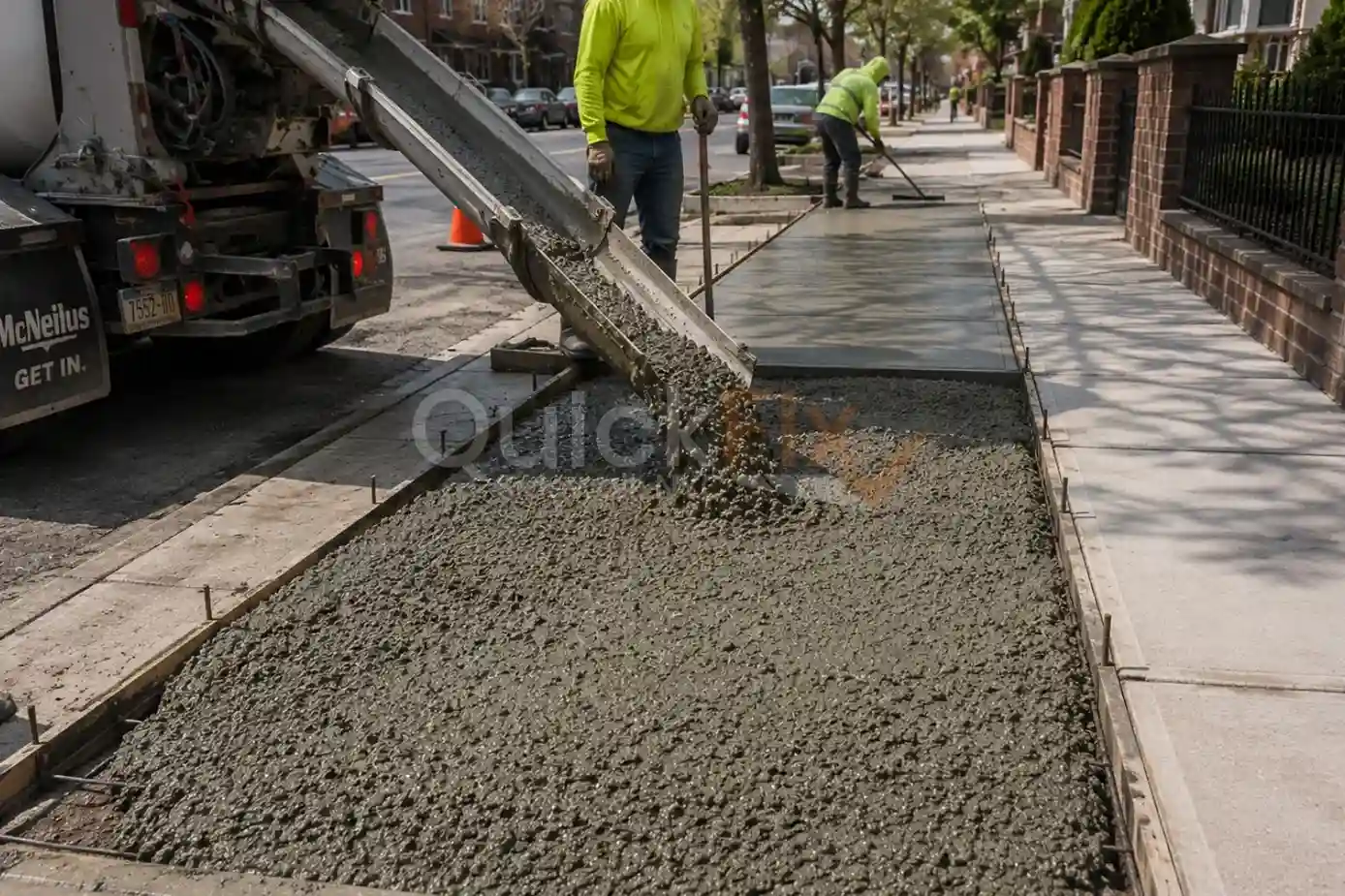
NYC DOT requires sidewalk concrete to reach a minimum of 3,000 to 4,000 PSI at 28 days with Class A-40 (4,000 PSI) mandatory for driveways and vehicular sections. The approved mix design must contain 5% to 8% entrained air, keep the water-to-cement ratio at or below roughly 0.44, use well-graded aggregate (typically No. 57 stone), and contain no calcium chloride admixtures. Meeting these specifications matters because non-compliant concrete spalls in NYC's freeze-thaw winters, fails DOT inspection, and can force you to tear out and repour the entire sidewalk at your own expense.
That's the short answer. Now let's break down each requirement one by one. what it means, what number you need to hit, and why the city insists on it.
1. Compressive Strength: The PSI Requirement
Compressive strength, measured in pounds per square inch (PSI), tells you how much crushing force cured concrete can withstand before it fails. The DOT tests this at 28 days, because concrete gains strength gradually as the cement hydrates. The number on the mix ticket is a 28-day promise, not a day-one reality.
The requirement breaks down by use:
- Standard pedestrian sidewalks generally call for a minimum of 3,000 PSI (Class B-32). This handles decades of foot traffic, strollers, and hand trucks without cracking under load.
- Driveways, aprons, curbs, and corner quadrants require Class A-40 concrete at a minimum of 4,000 PSI. Any section a vehicle crosses absorbs concentrated wheel loads from SUVs, box trucks, and delivery vans, loads that will crack a 3,000 PSI flag within a few years.
- High early strength mixes are used where a sidewalk must reopen fast, such as in busy commercial corridors. These accelerated-cure mixes reach 2,000 PSI in under 24 hours, allowing pedestrian traffic to return almost immediately while the concrete continues curing toward full strength.
The practical takeaway: know which sections of your sidewalk are vehicular and order the higher class for them. Mixing this up is one of the most common and most expensive sidewalk replacement mistakes in the city.
2. Water-to-Cement Ratio: The Most Important Number in the Mix
The specification caps the water-to-cement ratio at roughly 0.44 by weight, and some applications push it closer to 0.40. This single number controls almost everything about how the concrete performs.
The chemistry is simple: cement needs only a fixed amount of water to hydrate and cure. Every drop beyond that eventually evaporates, leaving behind microscopic pores and capillaries. The wetter the original mix, the more porous the finished slab, and porous concrete is weak concrete that drinks in water and road salt, then cracks and scales when winter hits.
This is why a professional crew never "sweetens" a stiff load with a hose on site. A soupier mix spreads and finishes beautifully, but it quietly destroys the strength and density the specification exists to guarantee. If you see water being added to the truck at your curb, that's a red flag worth questioning.
3. Air Entrainment: The 5% to 8% That Saves Your Sidewalk Every Winter
NYC DOT requires 5% to 8% entrained air in the mix. Billions of microscopic, evenly distributed bubbles created by a chemical admixture at the plant.
It sounds like a defect, but it's the sidewalk's survival mechanism. Concrete absorbs some moisture, and when that trapped water freezes, it expands by roughly 9%. In dense, non-air-entrained concrete, the expanding ice has nowhere to go, so it pushes outward with tremendous force. After a few dozen freeze-thaw cycles, the surface begins to spall, flaking, pitting, and scaling away in patches. Add deicing salt, which multiplies both the freeze-thaw cycles and the moisture the slab absorbs, and unprotected concrete simply doesn't survive a New York winter.
Those entrained air voids act as millions of tiny pressure-relief chambers, giving freezing water room to expand harmlessly. It's the difference between a sidewalk that shrugs off twenty winters and one that looks decades old after its first.
4. Aggregate and Proportioning: The Skeleton of the Slab
The DOT specifies well-graded coarse aggregate, commonly a No. 57 stone blend proportioned with Portland cement for proper workability and finish.
"Well-graded" means the stone comes in a healthy range of sizes, so smaller pieces nest into the gaps between larger ones. This minimizes the voids that cement paste has to fill, producing a denser, stronger, more economical slab. Poorly graded aggregate does the opposite: it creates a honeycomb of paste-filled gaps that weakens the concrete and invites cracking.
Proper proportioning also controls slump, the wet concrete's consistency, which is what allows crews to place, screed, and finish a flat, even surface without overwatering the mix.
5. Admixture Rules: Why Calcium Chloride Is Banned
NYC DOT strictly prohibits calcium chloride as a separate admixture and limits the total acid-soluble chloride ion content of the mix.
For generations, calcium chloride was the cheap way to accelerate curing in cold weather, but chlorides are brutally corrosive to steel. New York sidewalks sit on top of rebar, wire mesh, steel-faced curbs, and a dense network of buried utilities. When embedded steel rusts, it expands, and that expansion cracks concrete from the inside out. No surface repair can fix corrosion damage that starts within the slab, which is why the city bans the problem at the recipe stage.
6. Compliance and Cost: What Happens If You Get It Wrong
If a newly poured sidewalk fails inspection, for example, short on strength, missing proper air entrainment, or otherwise off-spec, the DOT can issue a violation and require the owner to remove and replace the sidewalk at their own expense. That means paying for demolition, disposal, and a complete second installation. The modest price difference between a bargain mix and a genuine DOT-class mix is the cheapest insurance in construction.
Proper mix design also underpins ADA compliance. Controlled slump and consistency are what allow contractors to form crisp truncated domes on curb ramps, hold accurate cross-slopes, and finish level walking surfaces that pass post-installation review. Sloppy concrete makes sloppy geometry, and sloppy geometry fails inspection.
Conclusion
Order the right class for the right section, Class A-40 at 4,000 PSI wherever vehicles cross, and the standard sidewalk class elsewhere, with 5% to 8% entrained air, a capped water-cement ratio, proper aggregate, and no chloride accelerators. Yes, these standards are technical, but here's the thing: you don't need to worry about any of it. All you need to do is give us a call, and we'll handle the rest.
At QuickFix Sidewalk NYC, our concrete specialists have extensive knowledge of NYC DOT specifications and complete know-how of the installation process, from ordering the correct concrete class to passing final inspection. From permits to the perfect pour, we make sure your sidewalk is done right the first time, fully compliant, built to last, and violation-free.
Call us today at (718) 682-6680 for a free estimate, and let the experts handle your sidewalk from start to finish.