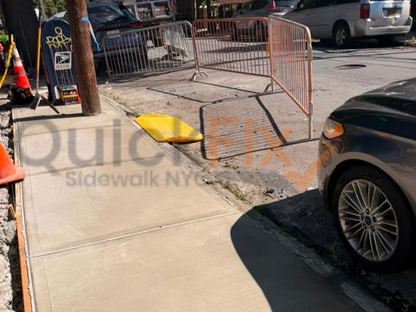
If someone falls on your sidewalk in New York City, the short answer is yes, you can be held liable in most cases. That catches a lot of property owners off guard, since sidewalks sit on public land and most people assume the city handles what happens there. In New York City, that assumption has been wrong since 2003.
We work with property owners across the Bronx, Brooklyn, Manhattan, and Queens who find this out the hard way, usually after a DOT violation notice or a call from their insurance company. Here is what the law says, who it applies to, and how to stay protected.
The Law That Shifted Responsibility to Property Owners
Before 2003, the city carried most of the responsibility for sidewalk conditions. That changed with NYC Administrative Code Section 7-210, sometimes called the sidewalk liability law. It places the duty to keep a sidewalk in a reasonably safe condition on the owner of the property it sits in front of, not the city.
If a defect, a crack, a raised slab, a tree root heave, causes an injury, the property owner can be held financially responsible. This applies to commercial buildings, apartment buildings, and mixed use properties across all five boroughs. The city passed this law as a cost saving move, reasoning that the owner who benefits from the property should also carry the responsibility for the sidewalk in front of it.
The Exception Most Owners Get Wrong
There is one meaningful exception. If your property is a one, two, or three family home that is owner occupied and used only for residential purposes, the city generally remains liable for the sidewalk instead of you. This does not apply to rental properties, mixed use buildings, or commercial property, and it does not apply if you rent out even part of an otherwise qualifying home.
Even with this exception, we would not treat it as a free pass. Insurance companies ask about sidewalk condition during underwriting, and a damaged sidewalk can complicate a sale or refinance. It also will not protect you from a DOT violation, which is a separate issue with its own repair deadline, typically 75 days from the notice date.
What Counts as a "Reasonably Safe" Sidewalk
The law does not require a perfect sidewalk, it requires a reasonably safe one. Courts generally look at whether the owner had actual notice of a defect, meaning someone reported it, or constructive notice, meaning it existed long enough that a reasonable inspection would have caught it. Common issues include cracked or uneven flags, sunken sections, tree root damage, and gaps at seams or curbs.
This duty also cannot be handed off. Hiring a management company or a tenant to watch the sidewalk does not remove your responsibility. If it causes an injury, the obligation still traces back to the owner.
Snow and Ice Follow a Different Set of Rules
Winter adds another layer. Under Administrative Code Section 16-123, owners must clear snow and ice within four hours after snowfall stops, excluding the hours between 9pm and 7am. If snow stops overnight, clearance is generally required by 11am. When ice cannot be fully removed, sand or salt is required in the meantime to cut down on slipping risk.
Courts generally do not expect owners to clear a sidewalk while snow is still falling, but that protection ends once the storm stops. Missing the window can mean a Department of Sanitation fine on top of any injury claim.
What Liability Actually Means for You
Being found liable usually means one of two things. Either your liability insurance covers the claim, common for commercial and rental properties with the right coverage in place, or you are personally exposed to a lawsuit, medical costs, and lost wages. New York uses a comparative negligence standard, so fault can be split with the injured person, but that only reduces damages, it does not eliminate exposure. Frequent claims can also raise premiums or make a policy harder to renew.
How to Lower Your Risk
The most effective move is dealing with sidewalk defects before they turn into a claim, not after. That means regular visual checks for cracks and lifting, prompt repairs when something looks off, and a snow removal plan you can actually execute within the four hour window.
This is where we come in. We have completed 9,500+ sidewalk projects across the Bronx, Brooklyn, Manhattan, and Queens, and we are licensed with the NYC DOB, DOT, DCA, NYC Parks, and OSHA. Every project comes with a written guarantee, and if a repair does not pass DOT inspection, we fix it at no cost to you. We also turn around free estimates within 24 hours, so you are not left waiting weeks while a hazard sits in front of your building.
If you are not sure your sidewalk would hold up to an inspection, or you already have a DOT violation notice in hand, call us at (718) 682-6680 and we will walk the property with you.
Frequently Asked Questions
Is the city ever responsible for a sidewalk injury?
Yes, mainly for owner occupied one, two, or three family homes, or cases where the city itself caused the defect. Suing the city also comes with strict notice requirements that do not apply to private property claims.
How long do I have to fix a sidewalk defect?
There is no fixed deadline for voluntary repairs, but waiting raises your exposure. If you receive a DOT violation, you typically have around 75 days before the city can step in and bill you for its own crew.
Does homeowners or commercial insurance cover sidewalk falls?
Most general liability and homeowners policies do, but limits and exclusions vary. It is worth confirming your policy specifically addresses sidewalk and premises liability.
What if I rent out my property?
The owner occupied exception only applies to homes the owner actually lives in. Rental properties do not qualify, and liability sits with you as the owner.
Can I be sued personally, not just my insurance company?
Yes, if a claim exceeds your coverage or your policy does not apply. This is one of the main reasons proactive repair is cheaper than waiting for a problem to surface.
If your sidewalk has visible cracks, lifted slabs, or a DOT violation attached to it, the fastest way to lower your risk is to get it fixed by a licensed contractor. Reach out to QuickFix Sidewalk NYC at (718) 682-6680 for a free estimate within 24 hours.